
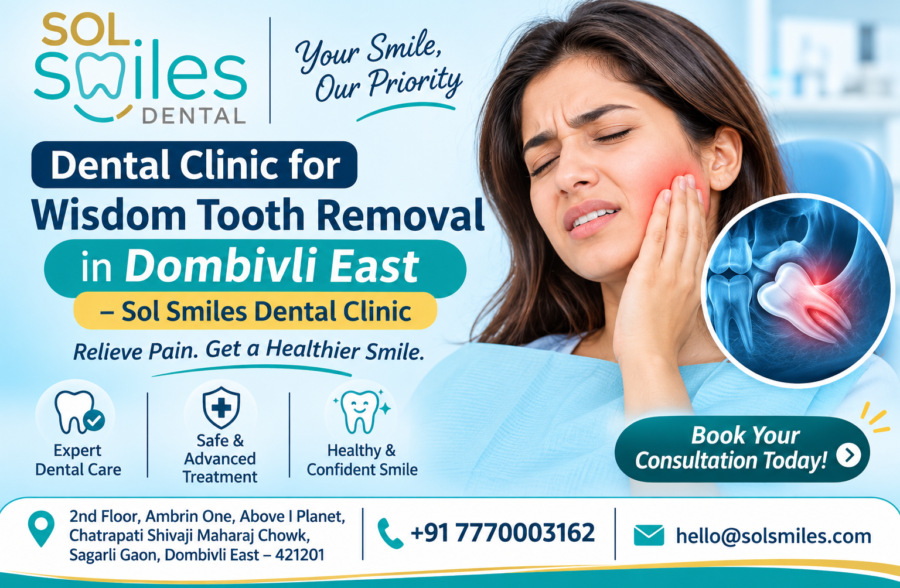
Experiencing pain at the back of your mouth, swollen gums, difficulty chewing or discomfort near your jaw? These symptoms may be associated with an erupting, impacted or infected wisdom tooth. If you are looking for a dental clinic for wisdom tooth removal in Dombivli East, understanding the cause of your discomfort and available treatment options is an important first step.
Sol Smiles Dental Clinic provides dental consultation and wisdom tooth extraction services in Dombivli East. The dental team evaluates wisdom tooth concerns, explains suitable treatment options and provides guidance for post-extraction care.
Conveniently located near Chhatrapati Shivaji Maharaj Chowk (Gharda Circle), the clinic is accessible to patients from Dombivli, Dombivli East, Thakurli and Palava City.
Whether you have occasional wisdom tooth pain, recurring gum swelling or an impacted wisdom tooth, a dental examination can help determine whether monitoring, treatment or extraction is appropriate.
Book a dental consultation: +91 7770003162
Table of Contents
- What Is a Wisdom Tooth?
- Why Do Wisdom Teeth Cause Problems?
- Common Signs and Symptoms of Wisdom Tooth Problems
- What Is an Impacted Wisdom Tooth?
- When Should You Consider Wisdom Tooth Removal?
- Does Every Wisdom Tooth Need to Be Removed?
- Wisdom Tooth Examination and Diagnosis
- Wisdom Tooth Removal Procedure: Step by Step
- Simple vs Surgical Wisdom Tooth Extraction
- Is Wisdom Tooth Removal Painful?
- Recovery After Wisdom Tooth Removal
- What to Eat After Wisdom Tooth Extraction
- Possible Complications and Warning Signs
- Wisdom Tooth Removal Cost in Dombivli East
- Why Consult Sol Smiles Dental Clinic?
- Meet the Dental Team
- Wisdom Tooth Treatment Near Dombivli, Thakurli and Palava City
- Frequently Asked Questions
- Book Your Wisdom Tooth Consultation
What Is a Wisdom Tooth?
Wisdom teeth are the third molars, which are the last teeth at the back of the upper and lower jaws. Most people develop up to four wisdom teeth, although some may have fewer or none.
These teeth generally begin to emerge during the late teenage years or early adulthood, commonly between 17 and 25 years of age. However, the timing varies from person to person.
Wisdom teeth do not always create problems. If there is enough space in the jaw and they erupt in a healthy position, they may function like other molars.
However, when there is insufficient space or the teeth develop at an incorrect angle, they may become partially erupted or impacted. This can lead to pain, swelling, food accumulation, gum infection and damage to neighbouring teeth.
A dental examination helps determine whether your wisdom teeth are healthy, require monitoring or need treatment.
Why Do Wisdom Teeth Cause Problems?
Wisdom teeth are located at the far end of the mouth, where cleaning can be difficult. Their position and the available space in the jaw can contribute to several dental problems.
Common reasons include:
1. Insufficient space in the jaw
When there is not enough room for a wisdom tooth to emerge properly, it may remain trapped beneath the gum or grow at an unusual angle.
2. Partial eruption
A wisdom tooth may emerge only partially, leaving a small gum flap around it. Food particles and bacteria can collect beneath this flap and cause inflammation or infection.
3. Incorrect tooth position
A wisdom tooth may grow sideways, tilt towards the neighbouring molar or remain positioned within the jawbone.
4. Difficulty maintaining oral hygiene
Because wisdom teeth are at the back of the mouth, brushing and flossing around them can be challenging. This may increase the risk of tooth decay and gum problems.
5. Damage to neighbouring teeth
An impacted wisdom tooth may contribute to decay, gum problems or damage affecting the second molar next to it.
Common Signs and Symptoms of Wisdom Tooth Problems
Wisdom tooth problems can develop gradually or cause sudden discomfort.
Watch for the following symptoms:
- Pain at the back of the mouth.
- Swollen or tender gums near the last molar.
- Difficulty opening your mouth fully.
- Pain while chewing or biting.
- Food frequently getting trapped behind the last tooth.
- Bad breath or an unpleasant taste in the mouth.
- Redness or inflammation around the wisdom tooth.
- Pain spreading towards the jaw or ear.
- Repeated gum infections near a partially erupted tooth.
- Swelling around the cheek or jaw.
These symptoms are not exclusive to wisdom teeth. Tooth decay, gum infections and other dental conditions can produce similar discomfort.
If you experience persistent pain or swelling, consult a dentist rather than relying only on temporary pain relief.
Important: Facial swelling accompanied by fever, rapidly increasing swelling, difficulty swallowing or difficulty breathing requires urgent medical or dental assessment. Breathing or swallowing difficulty is an emergency.
What Is an Impacted Wisdom Tooth?
An impacted wisdom tooth is a tooth that cannot erupt normally into its expected position because it is blocked by the gum, bone or another tooth.
Impaction may occur when there is insufficient space in the jaw or when the tooth develops at an unusual angle.
Common types of wisdom tooth impaction
1. Mesial impaction
The wisdom tooth is tilted towards the second molar in front of it.
2. Distal impaction
The tooth is angled towards the back of the mouth.
3. Horizontal impaction
The wisdom tooth lies almost horizontally within the jaw.
4. Vertical impaction
The tooth is positioned relatively upright but may not have enough space to erupt completely.
5. Soft-tissue impaction
The tooth has emerged partly or remains covered by gum tissue.
6. Bony impaction
The tooth remains partly or completely enclosed within the jawbone.
The type and depth of impaction influence the treatment approach. Your dentist evaluates the position of the tooth and its relationship with surrounding structures before recommending treatment.
When Should You Consider Wisdom Tooth Removal?
Wisdom tooth removal may be recommended when the tooth is causing or is associated with a dental problem that cannot be appropriately managed through observation or other treatment.
Common reasons include:
- Repeated pain or discomfort.
- Recurrent infection around a partially erupted tooth.
- Tooth decay that cannot be predictably restored.
- Damage or decay affecting the neighbouring second molar.
- Cystic or other pathological changes associated with the tooth.
- Gum disease or periodontal damage around the wisdom tooth.
- Repeated food trapping and associated inflammation.
- An impacted tooth causing other clinically significant problems.
The decision should be based on a clinical examination and appropriate imaging, not simply on the presence of a wisdom tooth.
If the tooth is healthy, fully erupted, functional and easy to clean, removal may not be necessary.
Does Every Wisdom Tooth Need to Be Removed?
No. Every wisdom tooth does not need to be removed.
A healthy wisdom tooth that has erupted properly, participates in chewing and can be maintained with good oral hygiene may be kept.
A dentist may recommend monitoring when:
- The tooth is healthy and functional.
- There is sufficient space for proper eruption.
- There is no associated infection or decay.
- The surrounding gum tissue is healthy.
- The tooth does not damage neighbouring teeth.
- The patient can maintain adequate cleaning.
Regular dental check-ups help identify any changes in the tooth or surrounding tissues.
Preventive removal is not automatically necessary for every impacted or unerupted wisdom tooth. The potential benefits and risks of monitoring versus extraction should be discussed with the treating dentist.
Wisdom Tooth Examination and Diagnosis
Before recommending wisdom tooth removal, a dentist evaluates the patient’s symptoms, dental condition and medical history.
At Sol Smiles Dental Clinic, the published wisdom tooth extraction service information describes consultation and X-ray assessment as part of treatment planning.
The evaluation may include:
1. Discussion of symptoms
The dentist asks about pain, swelling, previous infections, difficulty chewing and other concerns.
2. Clinical examination
The gums, wisdom tooth, neighbouring molars and surrounding tissues are examined.
3. Dental X-ray
An X-ray may be recommended to understand the position of the wisdom tooth, its roots, surrounding bone and nearby anatomical structures.
Depending on the complexity and location of the tooth, additional imaging such as a CBCT scan may be considered when clinically indicated.
4. Medical history review
The dentist should be informed about:
- Diabetes or blood pressure conditions.
- Allergies to medicines or anaesthetic agents.
- Blood-thinning medication.
- Previous surgical complications.
- Pregnancy or other relevant health conditions.
- Any medication or supplements currently being taken.
5. Personalised treatment planning
After evaluation, the dentist explains whether monitoring, simple extraction or surgical removal is appropriate.
Not every patient needs blood tests or antibiotics before extraction. These are considered only when indicated by the patient’s medical history and clinical condition.
Wisdom Tooth Removal Procedure: Step by Step
The exact procedure depends on whether the wisdom tooth is fully erupted, partially erupted or impacted.
The following is a general overview of how wisdom tooth extraction may be performed.
Step 1: Dental consultation
The dentist reviews the symptoms, examines the mouth and discusses the available treatment options.
Step 2: X-ray and treatment planning
Imaging helps assess the tooth’s position, root shape and relationship with surrounding structures. The dentist determines the appropriate approach.
Step 3: Preparation and local anaesthesia
The treatment area is cleaned and local anaesthesia is administered to numb the area.
You may feel pressure during the procedure, but the area should be adequately numb before extraction begins.
Step 4: Tooth removal
For a fully erupted tooth, the dentist may gently loosen and remove it using appropriate dental instruments.
For an impacted tooth, a surgical approach may be required. This can involve making a small opening in the gum, removing a limited amount of surrounding bone when necessary and dividing the tooth into smaller sections for removal.
Step 5: Cleaning and closure
The extraction site is inspected and cleaned. Stitches may be placed depending on the procedure.
Step 6: Post-treatment instructions
The dentist provides instructions regarding gauze pressure, food, oral hygiene, medicines and activity restrictions.
Step 7: Follow-up
A follow-up appointment may be recommended to review healing and remove stitches if non-dissolvable sutures were used.
Simple vs Surgical Wisdom Tooth Extraction
| Often not required | May be required | |
| Recovery | Often relatively straightforward | May involve more swelling and discomfort |
| Treatment planning | Clinical examination | Examination and appropriate imaging |
Your dentist will explain which procedure is appropriate after examining your wisdom tooth.
Is Wisdom Tooth Removal Painful?
This is one of the most common concerns among patients.
Wisdom tooth extraction is generally performed under local anaesthesia, which numbs the treatment area. During the procedure, you may notice pressure or movement, but you should not experience sharp pain when the area is adequately anaesthetised.
After the anaesthesia wears off, some discomfort, swelling or tenderness can occur.
The level of discomfort depends on several factors:
- Whether the tooth is fully erupted or impacted.
- The complexity of the extraction.
- The position and shape of the roots.
- The amount of surrounding tissue involved.
- Individual healing response.
Your dentist may recommend suitable pain-relief medication based on your medical history.
If you experience severe or increasing pain, contact your dentist for an assessment.
Recovery After Wisdom Tooth Removal
Recovery varies depending on the complexity of the extraction and individual healing.
Many patients experience some discomfort and swelling during the first few days. The symptoms generally improve gradually, although complete healing of the extraction site takes longer.
General recovery timeline
| Time after extraction | What you may experience |
|---|---|
| First 24 hours | Mild bleeding or oozing, tenderness and early swelling |
| Days 2–3 | Swelling and discomfort may be more noticeable |
| Days 4–7 | Symptoms generally begin improving |
| 1–2 weeks | Gum healing continues; follow-up may be advised |
| Following weeks | The deeper extraction site continues healing |
This is a general guide, not a guaranteed recovery schedule. Surgical extractions and individual medical conditions can affect healing time.
Important aftercare instructions
1. Follow gauze instructions
If gauze is provided, apply gentle, firm pressure as instructed to help control bleeding.
2. Avoid vigorous rinsing initially
Avoid forceful rinsing, spitting or disturbing the extraction site during the first 24 hours unless your dentist advises otherwise.
3. Avoid smoking and tobacco
Smoking and tobacco use can interfere with healing and increase the risk of complications such as dry socket.
4. Avoid strenuous activity
Rest after the procedure and follow your dentist’s advice about returning to exercise and other activities.
5. Maintain oral hygiene
Continue brushing other teeth gently. Clean around the extraction site according to your dentist’s instructions.
6. Take medicines only as advised
Follow the prescribed dosage and instructions. Do not start antibiotics or other medication without professional guidance.
7. Attend follow-up appointments
A follow-up helps the dentist assess healing and address any concerns.
What to Eat After Wisdom Tooth Extraction
Eating the right foods can help you remain comfortable while the extraction site heals.
Choose soft foods that require minimal chewing.
Recommended foods
- Curd or yoghurt.
- Mashed potatoes.
- Soft khichdi.
- Well-cooked and cooled dal.
- Soft scrambled eggs, if part of your diet.
- Smooth soups that are not hot.
- Mashed vegetables.
- Soft porridge.
- Banana mash.
Foods to avoid initially
- Hard nuts and seeds.
- Chips and crunchy snacks.
- Very hot foods and beverages.
- Hard or chewy foods.
- Spicy foods if they irritate the extraction site.
- Foods that easily get trapped in the wound.
- Alcohol during the initial healing period and while taking medicines that may interact with it.
Avoid drinking through a straw during the early healing period because suction can disturb the blood clot.
Gradually return to your normal diet as healing improves and your dentist advises.
Possible Complications and Warning Signs
Wisdom tooth removal is a common dental procedure, but complications can occur.
Understanding warning signs helps patients seek timely attention.
1. Dry socket
Dry socket occurs when the blood clot at the extraction site is lost or does not remain in place, exposing the underlying bone and causing significant pain.
Symptoms may include worsening pain a few days after extraction and an unpleasant taste or smell.
2. Infection
Possible symptoms include increasing swelling, fever, pus, worsening pain or feeling unwell.
3. Prolonged bleeding
Some minor oozing can occur initially. Persistent or heavy bleeding requires prompt professional advice.
4. Swelling and bruising
Some swelling and bruising may occur, particularly after surgical extraction. Increasing or persistent swelling should be assessed.
5. Nerve-related symptoms
Lower wisdom teeth can sometimes be close to nerves that supply sensation to the lip, chin and tongue. Temporary or, rarely, persistent altered sensation can occur.
The dentist assesses the tooth’s position and discusses relevant risks before treatment.
Wisdom Tooth Removal Cost in Dombivli East
The cost of wisdom tooth removal in Dombivli East varies from patient to patient. There is no single fixed price that applies to every wisdom tooth extraction.
Factors that may influence the treatment cost include:
- Whether the tooth is fully erupted or impacted.
- Whether simple or surgical extraction is required.
- Tooth position and root complexity.
- Type of diagnostic imaging required.
- Clinical complexity and treatment time.
- Follow-up care and other clinically necessary procedures.
A straightforward extraction may differ in cost from a complex surgical removal.
At Sol Smiles Dental Clinic, patients can contact the clinic for a consultation and an individual treatment estimate after dental assessment.
For appointment and treatment enquiries: +91 7770003162
Why Consult Sol Smiles Dental Clinic for Wisdom Tooth Removal in Dombivli East?
Choosing a dental clinic for wisdom tooth treatment involves more than finding a nearby dentist. Patients should understand the diagnosis, procedure, possible risks and recovery instructions before making a treatment decision.
Sol Smiles Dental Clinic focuses on consultation, assessment, treatment planning and patient guidance.
Patient-focused dental consultation
The dental team evaluates the patient’s symptoms and dental condition before discussing suitable treatment options.
Wisdom tooth assessment and extraction
The clinic lists wisdom tooth extraction as an available dental service. Treatment planning may include clinical examination and appropriate X-ray assessment.
Clear treatment communication
Understanding the reason for extraction and the available options can help patients make informed decisions.
Focus on patient comfort
Local anaesthesia and appropriate treatment techniques are used according to the procedure and individual requirements.
Aftercare and follow-up guidance
Patients receive instructions about recovery, oral hygiene, food choices and when to seek further attention.
Convenient Dombivli East location
The clinic is situated near Chhatrapati Shivaji Maharaj Chowk (Gharda Circle), making it accessible to patients from nearby localities.
Explore the clinic’s service page: Wisdom Tooth Extraction at Sol Smiles Dental Clinic
Meet the Dental Team
Dr. Aditi Mahale – Dentist
View Dr. Aditi Mahale’s Profile
Dr. Aditi Mahale is a dentist practising in Dombivli since 2009 and in the tribal region of Jawhar since 2018. She has training in preventive and restorative dentistry and specialised training in dental practice management.
She regularly updates her clinical knowledge through professional programmes. Dr. Aditi is a life member of the Indian Dental Association and served as President of the IDA Dombivli Branch from 2024 to 2025.
Her professional approach focuses on preventive dental care, restorative treatment and patient education.
Dr. Tejal Thorve – Dentist
View Dr. Tejal Thorve’s Profile
Dr. Tejal Thorve is a dentist at Sol Smiles Dental Clinic with experience in comprehensive dental care. Her published clinical profile includes dental implants, tooth extraction, restorative dentistry and preventive dental care.
Her approach includes detailed dental examination, personalised treatment planning, clear communication, patient comfort and follow-up guidance.
Patients seeking consultation for tooth pain, impacted teeth, tooth removal or other dental concerns can discuss their condition with the dental team.
Wisdom Tooth Treatment Near Dombivli, Thakurli and Palava City
If you are searching online for wisdom tooth removal near your home, choosing a conveniently located dental clinic can make consultation and follow-up visits easier.
Sol Smiles Dental Clinic is located in Dombivli East and serves patients looking for dental consultation and treatment from surrounding areas.
Wisdom Tooth Removal in Dombivli East
Patients living in Dombivli East can visit Sol Smiles Dental Clinic for wisdom tooth pain assessment, examination of impacted teeth and consultation regarding extraction.
The clinic is located near Chhatrapati Shivaji Maharaj Chowk, also known as Gharda Circle, at Ambrin One, above I Planet, Sagarli Gaon.
Wisdom Tooth Removal in Dombivli
If you are searching for wisdom tooth extraction in Dombivli, a dental consultation can help identify the cause of pain, swelling or discomfort at the back of your mouth.
Sol Smiles Dental Clinic in Dombivli East provides a convenient option for patients seeking wisdom tooth evaluation and treatment.
Wisdom Tooth Pain Treatment Near Thakurli
Patients from Thakurli looking for a dentist for wisdom tooth pain can visit Sol Smiles Dental Clinic in Dombivli East.
If you experience recurring gum swelling, pain while chewing or difficulty opening your mouth, arrange a dental examination to understand the cause.
Wisdom Tooth Extraction Near Palava City
Residents of Palava City looking for wisdom tooth consultation or extraction can consider visiting Sol Smiles Dental Clinic in Dombivli East.
A clinical examination and appropriate imaging help determine whether the wisdom tooth needs monitoring, treatment or removal.
Local service area: Dombivli | Dombivli East | Thakurli | Palava City | Sagarli Gaon | Gharda Circle
Frequently Asked Questions About Wisdom Tooth Removal
1. Where can I find a dental clinic for wisdom tooth removal in Dombivli East?
Sol Smiles Dental Clinic is located at 2nd Floor, Ambrin One, Above I Planet, Chhatrapati Shivaji Maharaj Chowk, Sagarli Gaon, Dombivli East – 421201. The clinic lists wisdom tooth extraction as one of its dental services. Call +91 7770003162 to book a consultation.
2. How do I know if my wisdom tooth needs to be removed?
Persistent pain, repeated gum infections, tooth decay, damage to neighbouring teeth or other complications may indicate a need for removal. A dentist must examine the tooth and review appropriate imaging before recommending extraction.
3. Is wisdom tooth removal painful?
Local anaesthesia is used to numb the treatment area. You may feel pressure during extraction, but sharp pain should not be expected when the area is adequately anaesthetised. Some discomfort and swelling may occur afterward.
4. How long does wisdom tooth removal take?
The procedure time depends on the position of the tooth, root shape and complexity of extraction. A simple extraction may take less time than a surgical removal of an impacted tooth. Your dentist can provide an estimate after assessment.
5. What is an impacted wisdom tooth?
An impacted wisdom tooth is one that cannot erupt normally because it is blocked by gum tissue, bone or another tooth. It may be partly erupted or completely trapped beneath the gum or jawbone.
6. Does every impacted wisdom tooth require surgery?
No. Treatment depends on the tooth’s position, symptoms and associated risks. Some teeth may be monitored, while others may require surgical removal. Your dentist will explain the appropriate approach.
7. Can wisdom tooth pain go away on its own?
Some discomfort may settle temporarily, but recurring pain can indicate an underlying problem such as inflammation, infection or decay. Persistent or repeated symptoms should be examined by a dentist.
8. Can wisdom teeth cause headaches or ear pain?
Pain from a wisdom tooth or surrounding tissues may sometimes be felt around the jaw or nearby areas. However, headaches and ear pain can have several causes, so a dental examination is needed to identify the source.
9. How many days does it take to recover after wisdom tooth removal?
Many patients notice improvement over several days, but recovery varies. Gum healing may take one to two weeks or longer, while deeper tissues continue healing over subsequent weeks.
10. What should I eat after wisdom tooth extraction?
Soft foods such as curd, mashed potatoes, soft khichdi, porridge and cooled soups are generally suitable initially. Avoid hard, crunchy, very hot or irritating foods until your dentist advises that normal eating can resume.
11. Can I brush my teeth after wisdom tooth removal?
Yes, maintaining oral hygiene is important. Brush other teeth gently and avoid disturbing the extraction site. Follow your dentist’s instructions about when and how to clean near the wound.
12. Is swelling normal after wisdom tooth removal?
Some swelling is common, particularly after surgical extraction. It may be more noticeable during the first two to three days and should generally begin to improve. Increasing swelling, fever or worsening pain requires professional assessment.
13. Can I go to work after wisdom tooth extraction?
This depends on the complexity of the extraction, discomfort and the nature of your work. Some patients return to normal activities relatively soon, while others may need additional rest. Follow your dentist’s advice.
14. Can I remove two wisdom teeth at the same time?
In selected cases, more than one wisdom tooth can be removed during the same appointment. The decision depends on the patient’s dental condition, medical history, tooth positions and treatment plan.
15. Is an X-ray necessary before wisdom tooth removal?
Dental imaging is commonly recommended to assess the tooth’s position, roots and surrounding structures. The dentist determines which type of imaging is appropriate for the individual case.
16. What happens if I do not remove an infected wisdom tooth?
An untreated infection may worsen or spread to surrounding tissues. If you experience pain, swelling, fever or difficulty opening your mouth, seek prompt dental assessment.
17. Can wisdom tooth removal damage nearby teeth?
The dentist plans the procedure to protect neighbouring teeth and surrounding structures. However, the risk of complications depends on the tooth’s position and complexity. These risks should be discussed before treatment.
18. How much does wisdom tooth removal cost in Dombivli East?
The cost depends on whether simple or surgical extraction is required, the tooth’s position, diagnostic imaging and clinical complexity. Contact Sol Smiles Dental Clinic for an individual estimate after consultation.
19. Where can I get wisdom tooth pain treatment near Thakurli?
Sol Smiles Dental Clinic in Dombivli East is accessible to patients from Thakurli. You can call +91 7770003162 to arrange a dental consultation.
20. Does Sol Smiles Dental Clinic provide wisdom tooth extraction near Palava City?
Sol Smiles Dental Clinic in Dombivli East lists wisdom tooth extraction among its services and can be contacted by patients from Palava City for consultation and treatment enquiries.
21. Who should I consult for wisdom tooth removal at Sol Smiles Dental Clinic?
You can contact Sol Smiles Dental Clinic to arrange an assessment with the appropriate dentist. The clinic’s published dental team profiles include Dr. Aditi Mahale and Dr. Tejal Thorve.
22. When should I seek urgent attention for wisdom tooth pain?
Seek urgent assessment if you have rapidly increasing facial swelling, fever, pus, difficulty opening your mouth or worsening pain. Difficulty breathing or swallowing requires emergency medical attention.
Book Your Wisdom Tooth Consultation at Sol Smiles Dental Clinic
Do not ignore recurring wisdom tooth pain, gum swelling or discomfort while chewing. Early dental assessment can help identify the cause of the problem and determine the most suitable treatment.
If you are searching for a dental clinic for wisdom tooth removal in Dombivli East, Sol Smiles Dental Clinic offers consultation and wisdom tooth extraction services for patients from Dombivli, Dombivli East, Thakurli and Palava City.
Sol Smiles Dental Clinic – Your Smile, Our Priority.
Phone: +91 7770003162
Email: hello@solsmiles.com
Clinic Hours: Monday–Saturday, 10:00 AM–8:00 PM
Book your dental consultation: Call Sol Smiles Dental Clinic | Get Directions