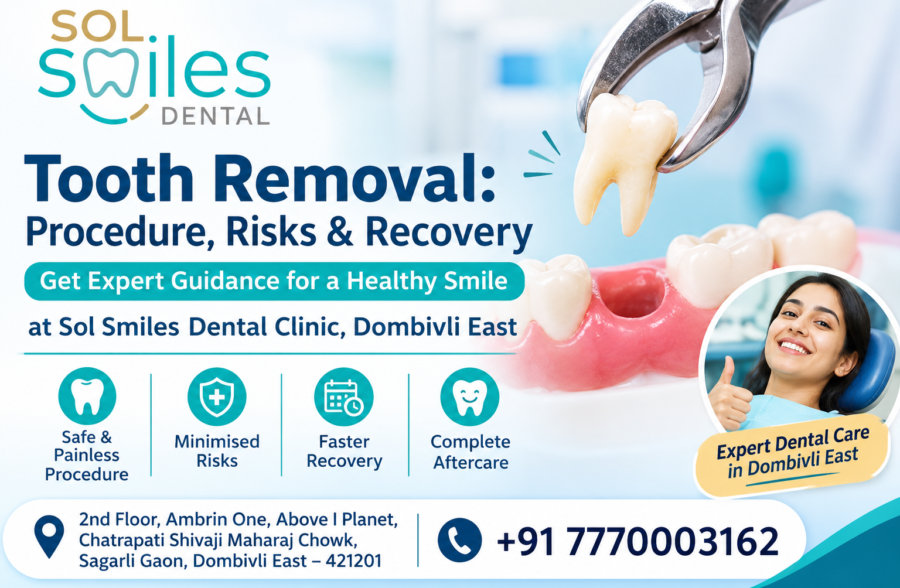
Tooth pain, severe tooth decay, infection, or a damaged tooth can affect your ability to eat, speak, and enjoy everyday activities. Sometimes, despite the availability of modern dental treatments, removing the affected tooth becomes the best option to protect your overall oral health.
Tooth removal, also known as tooth extraction, is a common dental procedure performed to remove a damaged, infected, loose, or problematic tooth. With proper diagnosis, modern dental techniques, local anaesthesia, and appropriate aftercare, most patients can undergo tooth extraction comfortably and recover without major complications.
If you are looking for safe and professional tooth removal in Dombivli East, understanding the procedure, reasons, potential risks, recovery process, and precautions can help you make an informed decision.
At Sol Smiles Dental Clinic, Dombivli East, patients receive personalised dental consultations and treatment recommendations based on their oral health requirements.
In this comprehensive guide, we explain everything about tooth removal, including when extraction is necessary, how dentists perform the procedure, what risks are involved, how long recovery takes, and what you should do after getting a tooth removed.
What Is Tooth Removal?
Tooth removal or tooth extraction is a dental procedure in which a dentist removes a tooth from its socket in the jawbone.
It may be recommended when a tooth is severely decayed, broken, infected, loose due to gum disease, impacted, or causing overcrowding.
There are two main types of tooth extraction:
- Simple Tooth Extraction: Removal of a visible tooth using specialised dental instruments.
- Surgical Tooth Extraction: Removal of a broken, impacted, or partially erupted tooth that may require a small incision in the gum.
Most extractions are performed under local anaesthesia to minimise pain during the procedure.
Table of Contents
- What Is Tooth Extraction?
- Why Do You Need Tooth Removal?
- Types of Tooth Extraction
- When Should a Tooth Be Removed?
- Tooth Extraction Procedure: Step-by-Step
- Is Tooth Extraction Painful?
- What Are the Risks and Complications?
- Tooth Extraction Recovery Timeline
- What to Eat After Tooth Removal?
- What Should You Avoid After Tooth Extraction?
- How to Take Care of Your Mouth After Extraction?
- When Should You Contact Your Dentist?
- How Much Does Tooth Extraction Cost in Dombivli East?
- What Happens If You Don’t Replace an Extracted Tooth?
- Why Choose Sol Smiles Dental Clinic in Dombivli East?
- Frequently Asked Questions About Tooth Removal
1. What Is Tooth Extraction?
Tooth extraction is a dental treatment in which a dentist removes a tooth from its supporting gum tissue and jawbone socket.
A natural tooth is generally preserved whenever possible. Treatments such as dental fillings, root canal treatment, and dental crowns may help save damaged teeth.
However, when a tooth cannot be restored successfully or creates a risk to surrounding teeth and tissues, extraction may become necessary.
Tooth extraction may be recommended for:
- Severely decayed teeth.
- Teeth damaged due to accidents or injuries.
- Advanced gum disease.
- Dental infections and abscesses.
- Impacted wisdom teeth.
- Overcrowded teeth requiring orthodontic treatment.
- Loose teeth with significant supporting bone loss.
- Retained or problematic milk teeth.
The dentist examines your teeth, gums, and surrounding structures before deciding whether extraction is the most suitable treatment.
2. Why Do You Need Tooth Removal?
Not every damaged or painful tooth needs to be removed. Dentists first evaluate whether the tooth can be saved through restorative treatment.
Here are some common situations where tooth extraction may be recommended.
A. Severe Tooth Decay
Untreated cavities can gradually damage the outer enamel, inner dentin, and dental pulp.
When tooth decay becomes extensive and the remaining tooth structure cannot be restored, extraction may be necessary.
Early treatment of dental cavities can often prevent the need for tooth removal.
B. Severe Tooth Infection
A bacterial infection inside the tooth can cause severe pain, swelling, and the formation of a dental abscess.
Root canal treatment may save many infected teeth. However, if the tooth is extensively damaged or cannot be restored, removal may be recommended.
C. Broken or Cracked Teeth
Teeth may break because of accidents, sports injuries, biting hard objects, or weakened tooth structure.
If a fracture extends below the gum line or into the root in a way that makes the tooth unrestorable, extraction may be required.
D. Advanced Gum Disease
Periodontal disease affects the gums and supporting bone around the teeth.
In advanced cases, significant bone loss can cause teeth to become loose. If the supporting structures are severely damaged, removing the affected tooth may be necessary.
E. Impacted Wisdom Teeth
Wisdom teeth are the last molars to develop, usually appearing during the late teenage years or early adulthood.
Sometimes, there is insufficient space for these teeth to erupt properly.
This can result in:
- Pain at the back of the jaw.
- Swollen or infected gums.
- Food getting trapped around the tooth.
- Difficulty opening the mouth.
- Damage to neighbouring teeth.
- Repeated gum infections.
Depending on the condition and position of the wisdom tooth, your dentist may recommend monitoring or surgical removal.
F. Orthodontic Treatment
Some patients have overcrowded teeth or insufficient space for proper alignment.
In selected orthodontic cases, removing one or more teeth may create the space needed to align the remaining teeth.
This decision should be made after a complete orthodontic assessment.
G. Retained Milk Teeth
Sometimes, baby teeth do not fall out naturally, even after permanent teeth begin to erupt.
A dentist may recommend removing the retained milk tooth if it interferes with the normal eruption or alignment of permanent teeth.
3. Types of Tooth Extraction
Tooth extraction is broadly classified into two categories.
A. Simple Tooth Extraction
A simple extraction is performed when the tooth is visible above the gum line and can be accessed easily.
Procedure:
- The dentist examines the affected tooth.
- Local anaesthesia is administered.
- Specialised instruments are used to loosen the tooth.
- Dental forceps are used to gently remove the tooth.
- The extraction socket is checked and gauze is placed to control bleeding.
Simple extraction is commonly used for teeth that are severely decayed, damaged, or loose but remain accessible.
B. Surgical Tooth Extraction
Surgical extraction is required when a tooth is difficult to access or cannot be removed through a simple extraction technique.
It is commonly performed for:
- Impacted wisdom teeth.
- Broken teeth with roots remaining below the gum line.
- Teeth that have not fully erupted.
- Teeth with complex root structures.
Procedure:
- The dentist evaluates the tooth using clinical examination and appropriate dental imaging.
- Local anaesthesia is administered.
- A small incision may be made in the gum.
- A small amount of surrounding bone may need to be removed.
- In certain cases, the tooth is divided into smaller sections for easier removal.
- The extraction area is cleaned.
- Stitches may be placed if required.
Surgical extraction generally requires more healing time than a simple extraction.
4. When Should a Tooth Be Removed?
You should visit a dentist if you experience any of the following symptoms:
| Symptoms | Possible Dental Problem |
|---|---|
| Continuous toothache | Deep decay or infection |
| Swelling around the tooth | Dental infection or abscess |
| Broken tooth | Trauma or extensive decay |
| Loose permanent tooth | Advanced gum disease |
| Pain at the back of the jaw | Possible wisdom tooth problem |
| Difficulty chewing | Damaged or infected tooth |
| Repeated gum swelling | Possible infection around an impacted tooth |
| Food getting trapped around wisdom teeth | Partially erupted tooth |
Important: These symptoms do not automatically mean that your tooth needs extraction. A professional dental examination is necessary to determine the appropriate treatment.
Do not ignore persistent tooth pain or swelling. Early dental treatment may help save your natural tooth.
5. Tooth Extraction Procedure: Step-by-Step
Many patients feel anxious about tooth removal because they do not know what happens during the procedure.
Understanding the treatment process can help reduce anxiety.
Here is how a typical tooth extraction procedure works at a dental clinic.
Step 1: Dental Consultation and Examination
The dentist examines the affected tooth, surrounding gums, and oral tissues.
You may be asked about:
- Duration of tooth pain.
- Previous dental treatments.
- Existing medical conditions.
- Current medications.
- Drug allergies.
- Previous reactions to dental anaesthesia.
Step 2: Dental X-Ray
Depending on the condition, the dentist may recommend an X-ray to evaluate:
- Tooth root structure.
- Position of the affected tooth.
- Surrounding bone.
- Presence of infection.
- Position of impacted wisdom teeth.
- Proximity to important nerves or sinuses.
Dental imaging helps the dentist plan the extraction safely.
Step 3: Medical Assessment
Inform your dentist if you have diabetes, high blood pressure, heart conditions, bleeding disorders, or any other medical condition.
Also disclose all medications, especially blood thinners, and any history of medication allergies.
Blood tests may be recommended when medically indicated.
Step 4: Administration of Local Anaesthesia
Local anaesthesia is administered around the affected tooth.
It temporarily blocks pain sensation in the treatment area.
You may experience pressure or movement during the procedure, but you should not feel sharp pain. Inform your dentist immediately if you experience pain so that additional anaesthesia can be considered.
Step 5: Tooth Removal
The dentist carefully removes the tooth using the appropriate extraction technique.
The procedure may involve loosening the tooth, removing it with dental forceps, or performing a small surgical procedure for impacted or broken teeth.
Step 6: Bleeding Control
After removing the tooth, the dentist places sterile gauze over the extraction site.
You will be asked to bite gently but firmly to help control bleeding and allow a blood clot to form.
This blood clot plays an important role in the healing process.
Step 7: Stitches and Follow-Up
Stitches may be required after surgical extraction.
Your dentist will provide specific instructions regarding food, oral hygiene, medications, and recovery.
A follow-up appointment may be scheduled to evaluate healing and remove non-dissolving stitches if necessary.
6. Is Tooth Extraction Painful?
One of the most common questions patients ask is whether tooth removal hurts.
No, you should not experience sharp pain during a properly anaesthetised tooth extraction.
Local anaesthesia numbs the affected area before the dentist begins the procedure.
However, you may experience:
- Pressure around the tooth.
- Slight pulling sensations.
- Movement during extraction.
- Mild discomfort after the anaesthesia wears off.
Some soreness, swelling, and tenderness are normal after extraction.
The intensity of discomfort depends on the tooth’s condition, extraction complexity, and individual healing response.
Surgical extraction, particularly impacted wisdom tooth removal, may involve more postoperative discomfort than a simple extraction.
Your dentist may recommend appropriate pain-relief medication based on your medical history.
7. What Are the Risks and Complications of Tooth Extraction?
Tooth extraction is a commonly performed dental procedure. However, like any surgical treatment, it carries certain potential risks.
Understanding these complications helps patients identify problems early.
A. Bleeding
Minor bleeding or blood-stained saliva is common immediately after extraction.
It generally reduces as a blood clot forms.
However, persistent or heavy bleeding requires dental attention.
B. Swelling and Bruising
Some swelling around the extraction area or cheek may occur, especially after surgical extraction.
Swelling can increase during the first 48–72 hours before gradually improving.
Cold compresses may help reduce discomfort and swelling.
C. Dry Socket
Dry socket, medically known as alveolar osteitis, occurs when the protective blood clot is lost or fails to develop properly.
It can expose the underlying bone and cause significant pain.
Common symptoms include:
- Increasing pain a few days after extraction.
- Pain spreading towards the ear or jaw.
- Unpleasant taste in the mouth.
- Bad breath.
- Visible empty-looking extraction socket.
Smoking, vigorous rinsing, and disturbing the extraction site can increase the risk.
A dentist can manage dry socket through appropriate cleaning and medicated dressing when required.
D. Infection
Bacterial infection may occasionally develop after extraction.
Warning signs include:
- Increasing pain.
- Persistent or worsening swelling.
- Fever.
- Pus discharge.
- Unpleasant taste.
- Difficulty opening the mouth.
Contact your dentist if you notice these symptoms.
E. Nerve Injury
Certain lower wisdom teeth and molars may be located close to important nerves.
In uncommon cases, extraction may cause temporary or, rarely, persistent numbness or tingling in the lower lip, chin, or tongue.
Dental imaging helps assess these anatomical relationships before treatment.
F. Sinus Communication
The roots of some upper back teeth are close to the maxillary sinus.
Occasionally, removing an upper molar can create an opening between the mouth and sinus.
This may require additional treatment and precautions.
G. Delayed Healing
Healing may take longer in patients with uncontrolled diabetes, smokers, individuals with certain medical conditions, or patients taking specific medications.
Following postoperative instructions and attending follow-up appointments can help reduce complications.
Remember: Not every patient experiences these complications. Your dentist will explain the risks relevant to your individual dental condition before treatment.
8. Tooth Extraction Recovery Timeline
Recovery varies depending on the type of extraction, the patient’s health, and the complexity of the procedure.
Here is a general recovery timeline.
| Recovery Period | What to Expect |
|---|---|
| First 24 hours | Blood clot formation, mild bleeding, numbness wearing off and initial soreness |
| 24–48 hours | Swelling and tenderness may increase |
| 48–72 hours | Swelling may reach its peak and then begin improving |
| 3–5 days | Pain and swelling should generally start reducing |
| 7 days | Many patients feel considerably better |
| 1–2 weeks | Soft tissue healing progresses; surgical sites may need longer |
| Following weeks | Deeper bone healing continues |
The extraction socket may take several weeks to close over, while complete bone remodelling takes considerably longer.
Surgical wisdom tooth extraction may require additional recovery time.
How Long Does It Take to Recover From Tooth Extraction?
Most patients can resume normal daily activities within 24–48 hours after a straightforward extraction.
However, surgical extraction may require a few additional days of rest.
Always follow your dentist’s recommendations based on your treatment.
9. What to Eat After Tooth Removal?
Your diet plays an important role in recovery.
Choose soft foods that require minimal chewing and do not irritate the extraction site.
Recommended Foods After Tooth Extraction
First 24 Hours:
- Plain curd or yoghurt.
- Mashed potatoes.
- Soft banana.
- Cool or room-temperature smoothies eaten with a spoon.
- Soft, non-spicy foods.
After 24–72 Hours:
- Soft khichdi.
- Well-cooked dal.
- Mashed vegetables.
- Soft idli.
- Scrambled eggs, if preferred.
- Soft rice.
- Lukewarm, smooth soups.
After a Few Days:
You can gradually return to your regular diet as comfort improves and your dentist advises.
Chew on the opposite side of the extraction site.
Avoid foods that are too hot, hard, crunchy, sticky, or likely to get trapped in the wound.
10. What Should You Avoid After Tooth Extraction?
Proper precautions help protect the blood clot and reduce the risk of dry socket and bleeding.
Avoid the following activities, especially during the first 24 hours:
| Activity | Why You Should Avoid It |
|---|---|
| Smoking or vaping | Delays healing and increases complication risks |
| Drinking through a straw | Suction can disturb the blood clot |
| Vigorous mouth rinsing | May dislodge the blood clot |
| Spitting forcefully | Can disturb the healing socket |
| Hard and crunchy foods | May irritate the extraction site |
| Very hot food and drinks | Can increase discomfort and bleeding risk |
| Heavy exercise | May increase bleeding and swelling |
| Touching the wound | Can disturb the healing tissue |
| Alcohol consumption | May interfere with healing and medication safety |
Follow your dentist’s instructions regarding when to resume these activities.
11. How to Take Care of Your Mouth After Tooth Extraction?
Following proper dental aftercare instructions is essential for a smooth recovery.
1. Maintain Pressure on the Gauze
Bite on the gauze provided by your dentist for the recommended duration.
Avoid repeatedly removing it to check the extraction site.
If bleeding continues, follow your dentist’s instructions for applying fresh gauze and contact the clinic if it does not settle.
2. Apply a Cold Compress
Place a cold pack wrapped in a clean cloth against the outside of your cheek.
Use it intermittently, generally for 10–20 minutes at a time.
Never place ice directly against your skin.
3. Avoid Disturbing the Blood Clot
The blood clot protects the extraction wound.
Do not touch the socket with your fingers or tongue.
Avoid rinsing or spitting forcefully during the first 24 hours.
4. Maintain Oral Hygiene
Continue brushing your other teeth carefully.
Avoid directly brushing the extraction wound during the initial healing period.
After 24 hours, gentle warm salt-water rinses may be recommended by your dentist.
Do not rinse aggressively.
5. Take Prescribed Medication
Take painkillers and other medicines only as recommended by your dentist.
Antibiotics are not routinely necessary for every tooth extraction.
They should be taken only when clinically indicated.
Never discontinue prescribed medication or change your dosage without professional advice.
6. Get Adequate Rest
Avoid strenuous activities during the initial recovery period.
Sleep with your head slightly elevated if advised.
7. Attend Your Follow-Up Appointment
Your dentist may recommend a follow-up visit to check healing, particularly after surgical extraction.
12. When Should You Contact Your Dentist After Tooth Removal?
Some discomfort is expected after extraction. However, certain symptoms require prompt professional attention.
Contact your dentist if you experience:
- Heavy bleeding that does not stop despite applying firm pressure.
- Severe or worsening pain.
- Increasing facial swelling.
- Fever or chills.
- Pus or discharge from the extraction area.
- Bad taste accompanied by increasing pain.
- Persistent numbness or tingling.
- Difficulty opening your mouth.
Seek emergency medical care if you experience difficulty breathing or swallowing, rapidly spreading swelling, or other signs of a serious infection.
Do not delay treatment when these warning signs appear.
13. How Much Does Tooth Extraction Cost in Dombivli East?
The cost of tooth extraction in Dombivli East depends on several factors.
There is no single fixed price for every extraction because simple tooth removal and surgical extraction involve different levels of complexity.
Factors Affecting Tooth Extraction Cost
1. Type of Extraction
Simple extraction generally involves fewer procedural steps than surgical extraction.
2. Tooth Condition
Severe decay, broken roots, and impacted teeth may require additional treatment.
3. Dental X-Rays
The dentist may recommend diagnostic imaging depending on the condition.
4. Surgical Complexity
Impacted wisdom teeth and teeth with complicated root structures may require specialised surgical procedures.
5. Additional Treatment
Medication, follow-up appointments, and other clinically required procedures may affect the overall cost.
Looking for Affordable Tooth Extraction in Dombivli East?
If you are experiencing tooth pain or need a dental extraction, consult Sol Smiles Dental Clinic for a clinical examination and personalised treatment estimate.
The dentist will explain the recommended procedure and associated costs before proceeding.
Avoid selecting a dental treatment based only on price. Proper diagnosis, appropriate treatment planning, and postoperative care are important for your oral health.
14. What Happens If You Don’t Replace an Extracted Tooth?
Removing a tooth may solve an immediate dental problem, but the missing tooth can affect your oral health and bite over time.
Depending on the location and number of missing teeth, possible consequences include:
- Shifting of neighbouring teeth.
- Changes in bite alignment.
- Difficulty chewing certain foods.
- Changes in appearance, particularly when front teeth are missing.
- Gradual changes in the jawbone around the missing tooth.
- Overeruption of the opposing tooth.
What Are the Options for Replacing a Missing Tooth?
Your dentist may discuss the following options.
A. Dental Implants
Dental implants are artificial tooth roots placed in the jawbone to support replacement teeth.
They can provide a fixed tooth replacement option for suitable patients.
B. Dental Bridges
A dental bridge replaces a missing tooth using support from neighbouring teeth or other suitable structures.
C. Removable Partial Dentures
These are removable appliances designed to replace one or more missing teeth.
The appropriate option depends on your oral health, bone condition, budget, and treatment goals.
Discuss replacement options with your dentist after extraction.
15. Why Choose Sol Smiles Dental Clinic for Tooth Removal in Dombivli East?
Choosing the right dental clinic is important when you need tooth removal.
At Sol Smiles Dental Clinic, Dombivli East, patient comfort, proper diagnosis, and personalised dental care are important parts of the treatment approach.
Patient-Focused Dental Consultation
Every patient receives an individual assessment to determine whether tooth extraction is necessary or whether the natural tooth can be preserved.
Simple and Surgical Tooth Extraction
Treatment planning is based on the condition, position, and complexity of the affected tooth.
Diagnostic Assessment
Clinical examination and dental imaging, when required, help evaluate the tooth and surrounding structures before extraction.
Patient Comfort
Local anaesthesia is used to minimise discomfort during suitable extraction procedures.
Personalised Aftercare
Patients receive guidance about food, oral hygiene, medications, precautions, and recovery.
Follow-Up Support
Follow-up appointments help monitor healing and identify any complications that require attention.
Whether you need an assessment for a damaged tooth, a painful molar, or an impacted wisdom tooth, the dental team can guide you towards an appropriate treatment plan.
16. Frequently Asked Questions About Tooth Removal
Here are answers to some of the most common questions patients ask about tooth extraction.
Q1. Is tooth removal a painful procedure?
Tooth removal is generally performed under local anaesthesia, which numbs the treatment area. You may feel pressure or movement, but sharp pain should not occur. Mild soreness may develop after the anaesthesia wears off.
Q2. How long does a tooth extraction procedure take?
A simple tooth extraction may take only a few minutes. More complicated surgical extractions, particularly impacted wisdom teeth, can take longer depending on the position and condition of the tooth.
Q3. How many days does it take to recover after tooth extraction?
Most patients recover from a simple extraction within a few days. The initial gum healing generally takes around one to two weeks, although complete bone healing takes longer. Surgical extractions may require additional recovery time.
Q4. Can I eat immediately after tooth removal?
Wait until the local anaesthesia wears off before eating to avoid accidentally biting your cheek or tongue. Start with soft, cool or room-temperature foods and avoid chewing near the extraction site.
Q5. Can I brush my teeth after tooth extraction?
Yes. Continue cleaning your other teeth carefully. Avoid disturbing the extraction site during the first 24 hours. Resume gentle cleaning around the area according to your dentist’s instructions.
Q6. Is bleeding normal after tooth removal?
A small amount of bleeding or blood-stained saliva is normal during the initial recovery period. Persistent heavy bleeding is not normal and requires dental attention.
Q7. Can I drink tea or coffee after tooth extraction?
Avoid very hot beverages during the initial recovery period. Once the anaesthesia wears off and bleeding is controlled, follow your dentist’s instructions regarding when you can resume drinking tea or coffee.
Q8. Can I smoke after tooth extraction?
Smoking is strongly discouraged after extraction because it can delay healing and increase the risk of dry socket and infection. Avoid smoking for at least 48–72 hours, and preferably longer during healing, as advised by your dentist.
Q9. What is dry socket after tooth extraction?
Dry socket is a complication in which the protective blood clot is lost or does not develop properly. It can expose the underlying bone and cause severe pain, usually a few days after extraction. It requires dental treatment.
Q10. Can an infected tooth be removed?
Yes, an infected tooth may sometimes need extraction if it cannot be saved. However, some infected teeth can be treated successfully with root canal treatment. Your dentist will determine the appropriate option after examination.
Q11. Is tooth extraction safe for diabetic patients?
Tooth extraction can be performed in diabetic patients with appropriate medical assessment and treatment planning. Blood sugar control is important because uncontrolled diabetes may delay wound healing and increase infection risks. Discuss your medical history and medications with your dentist.
Q12. Can I go to work the next day after tooth removal?
Many patients can return to normal daily activities the next day after a simple extraction. However, surgical extraction may require additional rest depending on discomfort and swelling.
Q13. When can I eat normally after tooth extraction?
You can gradually return to your regular diet as tenderness improves. Avoid hard, crunchy, sticky, and very hot foods until the extraction site has healed sufficiently.
Q14. Does every wisdom tooth need to be removed?
No. Wisdom teeth that are healthy, properly positioned, and not causing problems may not require removal. Extraction is considered when there are clinical reasons such as repeated infection, damage, decay, or other complications.
Q15. What is the difference between simple and surgical tooth extraction?
Simple extraction removes a visible tooth using dental instruments. Surgical extraction involves additional steps, such as making an incision in the gum or removing a small amount of surrounding bone, when the tooth is impacted, broken, or difficult to access.
Q16. What should I do if my extraction site hurts after three days?
Some discomfort is expected, but increasing or severe pain after a few days may indicate dry socket or infection. Contact your dentist for an examination rather than trying to manage the problem yourself.
Q17. How much does tooth removal cost in Dombivli East?
The cost depends on whether the procedure is simple or surgical, the condition of the tooth, diagnostic requirements, and treatment complexity. Contact Sol Smiles Dental Clinic for an examination and personalised estimate.
Q18. Where can I get professional tooth extraction in Dombivli East?
You can consult Sol Smiles Dental Clinic, located at Ambrin One, above I Planet, Chatrapati Shivaji Maharaj Chowk, Sagarli Gaon, Dombivli East – 421201. Call +91 7770003162 to enquire about an appointment.
Conclusion: Get the Right Dental Advice Before Removing a Tooth
Tooth extraction is sometimes necessary to protect your oral health, eliminate persistent infection, and prevent further dental complications.
However, removing a natural tooth should always be considered after a proper dental examination. Modern dentistry offers several tooth-saving treatments, and extraction is recommended when it is clinically appropriate.
Understanding the procedure, possible risks, recovery timeline, and postoperative precautions can help you prepare for treatment and recover comfortably.
If you are experiencing tooth pain, swelling, a broken tooth, or wisdom tooth discomfort, do not ignore the symptoms.
Consult Sol Smiles Dental Clinic in Dombivli East for professional dental evaluation and personalised guidance on tooth extraction.
Book Your Dental Consultation Today!
Sol Smiles Dental Clinic – Dombivli East
📞 Phone: +91 7770003162
📧 Email: hello@solsmiles.com
🌐 Website: https://solsmiles.com/
🕒 Clinic Timings: Monday to Saturday, 10:00 AM – 8:00 PM.
Looking for tooth removal near you in Dombivli East? Schedule a dental consultation at Sol Smiles Dental Clinic and take the right step towards better oral health.